Watching a looped transformer think: where the hidden reasoning step lives
Thinking Machines built Inkling 2 Mini, a “looped” language model that reuses the same layers three times for every word. In their post, they asked researchers to study what actually happens inside those loops. I wanted to answer one simple question: when a looped model reasons, does each loop do one step?
I tested it twice: first on a tiny looped model I built myself, then on the real Inkling 2 Mini. The short answer is no, not one step per loop. But on the real model I found where the hidden reasoning step lives, and that each loop makes it stronger.
What is a looped transformer?
A normal language model passes each word up through a stack of layers, like floors in a building. Every layer is different, and more layers means more “thinking rounds”, but also a bigger model.
A looped model reuses the same layers again and again instead of adding more. Inkling 2 Mini has 24 layers: the first few run once (the “prelude”, which reads the question), the middle twelve run three times (the loop, where the thinking happens), and the last few run once (the “coda”, which writes the answer). So each word passes through 48 layer steps, using only 24 layers’ worth of weights.
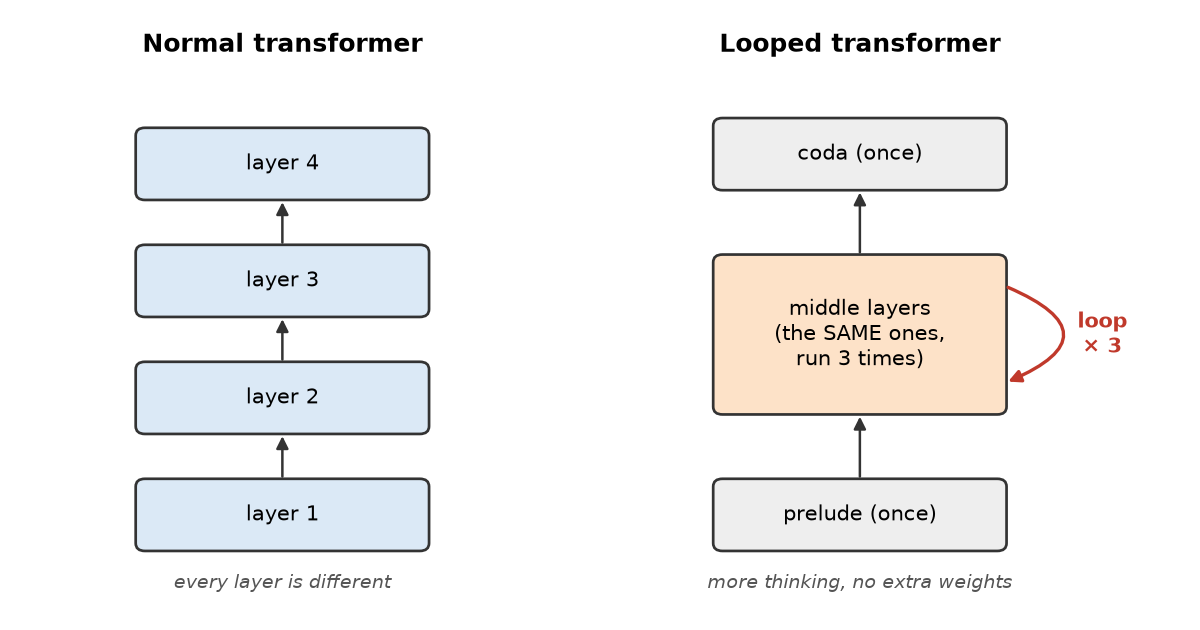
More thinking, no extra weights. But nobody had shown what the extra loops actually do.
The question, and the puzzle
To see reasoning steps, I needed a task with clear steps where I know every step’s answer. I used chains of friends:
Anna’s friend is Tom. Tom’s friend is Sara. Sara’s friend is Ben. Who is the friend of the friend of Anna?
To answer “Sara”, the model first has to work out “Tom” in its head. Each arrow is one step, called a “hop”, and the middle answer (Tom) is the hidden step: the model needs it, but never writes it. The names are made up, so the model can’t remember the answer; it has to follow the chain. I also added a few distracting facts about other people.
The hope was simple: loop 1 finds Tom, loop 2 finds Sara.
To look inside, I used probes. A probe is a tiny reader trained on the model’s internal numbers (its “thought” at one point) to answer a question like “which person is the hidden step?”. If the probe can read Tom from the thought after loop 1, the model is holding that step there. To keep it honest, I always compared against a control: a name that appears in the puzzle but is not on the path. If the probe reads both equally well, it’s only detecting “names that were mentioned”, not reasoning.
Part 1: a tiny looped model, built from scratch
I started small, with a looped model I built myself: a few transformer blocks, where one middle block is reused four times, next to a normal model with four different blocks for comparison.
Getting it to solve the puzzle took four tries, and every failure was a lesson:
- Too hard to start: with all puzzle lengths mixed from the beginning, it learned nothing. I switched to a curriculum: one-step puzzles first, longer ones later.
- A shortcut: it got stuck at exactly 50%. It had learned “the answer is the letter after the start of a chain”, without even reading the question. There were two chains, so it was guessing between two answers. I made the questions start at a random point in the chain.
- The wrong format: with each fact spread over several tokens, the tiny model couldn’t connect them. When I gave each fact its own position, it jumped to 100% on 1 to 4 steps within a few minutes of training.
Then I probed it after every loop. The result was clear, and repeated across three training seeds:
- Each loop does at most one step. I never saw a loop do two dependent steps at once at the question.
- The model uses only as many loops as it needs. A version with only 2 loops worked just as well as 4, and in three of five models, switching off all but one loop barely changed the accuracy.
- When it can, it avoids looping. The facts were quietly combining with each other (“Anna → Tom” plus “Tom → Sara” became “Anna → Sara”), a known trick called pointer jumping. That let the model skip steps in parallel, so the extra loops sat idle. When I blocked that trick, each step finally happened one at a time, but the model still used only the loops it needed.
So in the toy model: not one step per loop. Loops are used only when there’s no shortcut.
Part 2: inside the real Inkling 2 Mini
Inkling 2 Mini is far too big for my laptop, so I ran it through NDIF, a research service that hosts large models and lets you read their insides with a library called nnsight.
First, a quick look with the “logit lens”. This trick takes a thought from the middle of the model and runs it through the model’s own final word-picker: “if the model had to speak right now, what would it say?” On simple questions, the answer only appeared around layers 10–12, during the second and third loop runs (first at layer 12). The first loop run showed nothing.
The loops are not idle. I compared the model’s thought at the same layer between loop runs. The last loop run changed the thought the most, and it did so the same way whether the model got the answer right or wrong, like a fixed routine. When I made the third loop run do nothing, the model broke completely: on simple questions it went from 90% correct to 0%.
The puzzles were hard for it. Without writing out its thinking, Inkling solved about 80% of one-step questions, 37% of two-step ones and 17% of three-step ones.
Looking at the last word showed almost nothing. My first probes read the thought at the last word of the question, where the model is about to answer. The hidden person was only faintly readable there, about twice the control.
A better lens didn’t help with hidden steps. I also trained a “tuned lens”, a small translator per layer that makes middle thoughts readable as words. It read the model’s upcoming answer far better than the basic logit lens (around 50–70% agreement with the model’s real prediction, versus 1–25%). But it could not see the hidden step. That makes sense: a tuned lens is trained to predict what the model is about to say, and the hidden step is never said. To find a hidden step, you need a reader trained on the hidden step itself.
Where the hidden step lives
So I tried reading in different places. For each of 590 two-step puzzles, I read Inkling’s thought at four positions in the question: at the start name (“Anna”), at the question mark, at the end of the question, and at the last word.
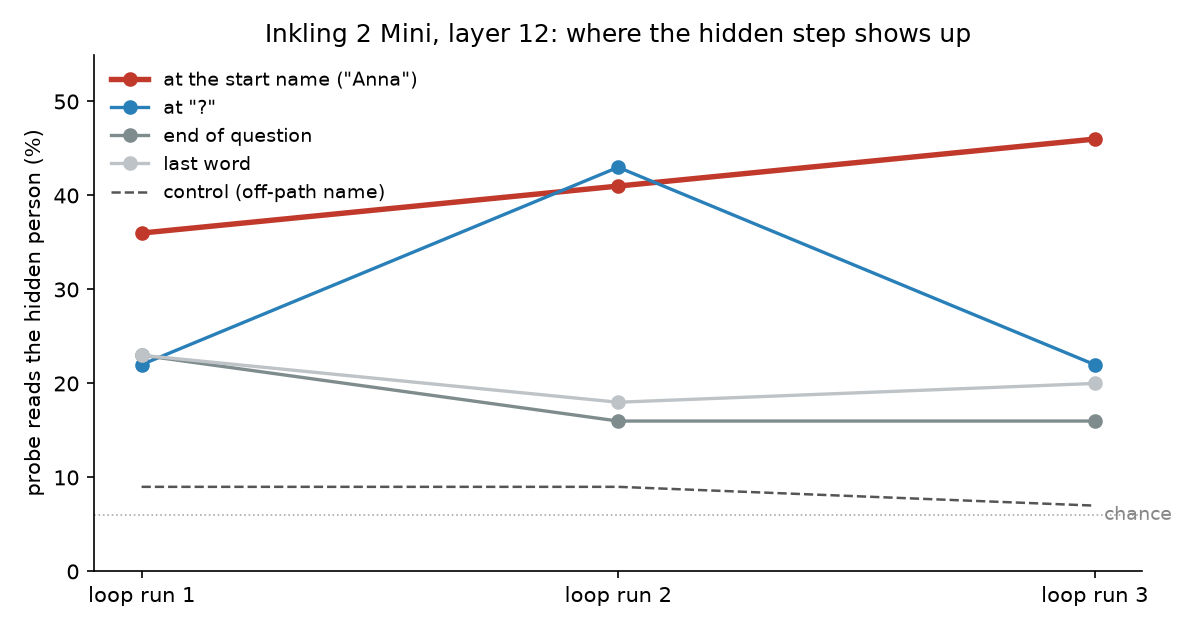
At the start name, at layer 12, the hidden person became clearly readable, and more so with every loop run: 36%, then 41%, then 46%, while the control name stayed around 7–9% (chance is 6%). At the question mark, it peaked in the second loop run and then dropped. At the end of the question and at the last word, it stayed weak, which is why my first probes saw so little.
In plain words: Inkling seems to work out the hidden step right where the starting name appears in the question, at layer 12, and each pass through the loop makes it stronger. It isn’t “one step per loop”. It’s one step, built up gradually across the loops, in one specific place. Layer 12 is also where the logit lens first found answers, so two different methods point to the same spot.
What I learned
- Models love shortcuts. I ran into four different ones. A correct answer tells you nothing about how the model got there, so check the how.
- How you present a task can matter more than the model. The same tiny model went from 12% to 100% when I changed how the facts were written.
- Look in the right place. The signal was at the start name, not at the last word, where everyone looks first.
- Always use a control. The off-path name kept me from fooling myself.
- Different tools answer different questions. The logit lens and tuned lens read what the model is about to say; a probe trained on the hidden step reads what it is thinking but not saying.
Limits and next steps
These are early findings. The Inkling results come from 590 puzzles, simple linear probes, and 12 sampled points inside the model, and Inkling only solved 38% of these puzzles without writing out its thinking. A probe also shows that information is readable, not that the model uses it. Next, I want to:
- probe all twelve looped layers at the start-name position, to see exactly where the step forms
- repeat it on a fresh set of puzzles
- run causal tests: change the hidden step at layer 12 and check whether the model’s answer changes. That would show the model actually uses it.
Code
Everything is open: the toy model, the probes and the Inkling scripts are at https://github.com/Lohitha0607/looped-reasoning, with a notebook you can run for free in Colab. The trained tuned lens is on Hugging Face: https://huggingface.co/loh0607/inkling-2-mini-tuned-lens.
Thanks
- Thinking Machines, for Inkling 2 Mini and for asking this question in the open
- NDIF and nnsight, for free access to the model
- Goodfire, whose early analysis of Inkling helped me know where to look
If you’re working on looped models or interpretability, I’d love to hear from you:
- GitHub: https://github.com/Lohitha0607
- X: https://x.com/Loh0607
- Hugging Face: https://huggingface.co/loh0607